January 15, 2010 Chicago Public Schools
FACT Sheet
Making Safer Schools: Demilitarizing Public Education
Researched and written by: Brian Galaviz, Jesus Palafox, Erica Meiners, Therese Quinn
On December 10, 1948 the General Assembly of the United Nations adopted and proclaimed the Universal Declaration of Human Rights. The United States voted in favor of the Declaration and agreed, with other signatories, to recognize and observe the rights it describes.
One section of the Declaration claims for children the rights to education directed at supporting the maintenance of peace:
Universal Declaration of Human Rights
Article 26. (1) Everyone has the right to education. Education shall be free, at least in the elementary and fundamental stages. Elementary education shall be compulsory. Technical and professional education shall be made generally available and higher education shall be equally accessible to all on the basis of merit.
(2) Education shall be directed to the full development of the human personality and to the strengthening of respect for human rights and fundamental freedoms. It shall promote understanding, tolerance and friendship among all nations, racial or religious groups, and shall further the activities of the United Nations for the maintenance of peace.
(3) Parents have a prior right to choose the kind of education that shall be given to their children.
Convention on the Rights of the Child
Article 2 of Optional Protocol to the Convention on the Rights of the Child, which the U.S. signed but, with only one other country, has not ratified, addresses the involvement of children in armed conflict:
States Parties shall ensure that persons who have not attained the age of 18 years are not compulsorily recruited into their armed forces.
Chicago’s system of public education has moved far from these global commitments to offering children a safe, civilian and non-coercive learning environment.
1) Chicago is the most militarized public school system in the nation and approximately 10,670 students, 95% students of color, are enrolled in:
- 6 Military high schools, one representing each branch of the military—Air Force, Navy, Marines, and two Army schools.
- 45 Junior Reserve Training Officer Corps Programs within high schools
- 20 Cadet Programs in middle schools
2) JROTC has replaced content courses and counts for PE credit in grades 9, 10.
3) Taxpayers subsidize the militarization of schools.
CPS total expenditures on ROTC programs for the school year 2007-08 was $12,885,966.60. Out of this $12,885,966.60 CPS received $3,810,924.45 from the department of defense, leaving Chicago taxes payers an invoice of $9,075,042.15.
4) The JROTC program has smaller class sizes, lower standards for teacher qualifications and instructors receive higher levels of compensation As of November 2, 2010 no JROTC instructor is identified as a certified teacher on the Illinois State Board of Education website.. The 2009-2010 median salary for a JROTC instructor was $75,823.24. In addition to pay inequalities, JROTC instructors are also given preferential treatment regarding class size. CPS schools are mandated to subsidize at least two JROTC instructors, no matter how many students they have and one additional instructor for every 50 students. Legally, JROTC programs must have a minimum enrollment of 100 students or 10% of the student population, whichever is lower. However, this law is not always enforced. For example, there are eleven JROTC programs in CPS that do not meet this threshold. Of those eleven schools, six of them have three JROTC instructors. That means three instructors teach less than 100 students. CPS would be the best school district in the nation if all of our teachers were given this type of preferential treatment.
5) Youth and their parents support military programs because they view these programs as opportunities to provide discipline, safety, academic and leadership opportunities. These same opportunities can be delivered through arts, sports, drama, martial arts, music – programs that have been largely cut from urban schools. Only one restrictive enrollment school in Chicago has a military program, Whitney Jones High School, and this program does not meet JROTC enrollment requirements.
6) Military programs offer false pathways to college and other post secondary benefits.
Only 43% of Military Personnel has received their GI benefits and the Average Net Payout to Veterans is less than $2200
7) Military programs in schools actively recruit young people.
a) “In recognition of the growing importance of the JROTC program to recruiting for the military services, the conferees increased the requested funding for this program by $13.5 million. The increased funding will facilitate the expansion of the program undertaken by the Secretary of Defense." (emphasis ours)
b) Field trips and guest speakers center military life:
The cadets in Rickover Naval Academy, have taken a school-sponsored field trip to the Naval Academy in Annapolis, MD
two years ago, RNA hosted Admiral Michael Mullen, the current Chairman of the Joint Chiefs of Staff. Mullen told the cadets that the "Navy was a great career choice."
c) A military, not civilian, culture permeates military schools.
Young people dressed in military uniform are introduced to the military hierarchy and way of life. This cultivation of a militarized mind is the best explanation for why “40-60% of all NJROTC [Naval Junior Reserve Officer Training Corps] graduates enter military service.” This statistic is especially telling considering that less than 1% of the population has served in the military at any given moment since 1975.
8) Don’t Ask, Don’t Tell is still military policy, though it is legislated to be phased out by an unspecified date. The U.S. military is a persistent site of gendered and sexual violence.
2007 research identified that no Chicago public military high school supported lesbian, gay, bisexual, and transgender students through the presence of a targeted student group, such as a Gay, Straight Alliance, although these clubs are common in many Chicago high schools.
We ask the CTU to:
Phase out JROTC programs and support the development of alternative programs to help foster discipline, leadership and college pathways for all students.
Until the phase-out is complete, The CTU should call for an immediate:
• Moratorium on the establishment of any new public military high schools, and JROTC and Cadet programs within schools.
• Cessation of public educational funding allocated to public military schools and programs targeted to discipline, leadership and safety development.
• End to JROTC as a Physical Education (PE) substitute.
• Halt to preferential treatment for JROTC instructors regarding class size and pay.
• Enforcement of JROTC laws, including shutting down under-enrolled programs.
• Development of visible support for LGBTQ teachers and students at public military schools.
In addition, we call on the CTU to:
• Implement a taskforce to investigate the working conditions at military schools and JROTC programs.
• Support the AFSC request to have the opt-out section included on the emergency forms
___
http://www.google.com/url?sa=t&source=web&cd=5&ved=0CCcQFjAE&url=http%3A%2F%2Fwww.usa-federal-forms.com%2Fusa-fedforms-dod-da%2Fdod-da-3126-nonfillable.pdf&rct=j&q=DA%20form%203126&ei=-pDQTKq9GeSInAejlLmNBg&usg=AFQjCNFWdT7Um0aLEKJB3BUiaevgEkzZzA&sig2=-PUUrv-50CKmbQYHKHMHDw&cad=rja
http://www.cps.edu/Schools/Find_a_school/Pages/Schoolsearchresults.aspx?Type=4&Filter=CPSSchoolGrade=High school;CPSSchoolType=Military%20academy
http://www.peaceworkmagazine.org/pwork/0506/050607.htm
“House Armed Service Committee Press Release: Conferees Reach Agreement on Fiscal Year 2001 Defense Bill.” October 6, 2000. http://www.hqda.army.mil/rio/hconfpress.pdf
http://www.truth-out.org/062909T
http://chicagojrotc.com/navy/navy_basic_facts.jsp?rn=3548084. 11/9/07
Segal, David R. Segal, Mady Wechsler. “America’s Military Population.” The Population Reference Bureau. http://www.prb.org/Source/ACF1396.pdf
Showing posts with label Chicago public schools. Show all posts
Showing posts with label Chicago public schools. Show all posts
Tuesday, January 18, 2011


Tuesday, July 28, 2009
Corruption in Chicago Schools?
It certainly shouldn't surprise any Chicagoan that the admissions process for our city's selective admission schools might be tainted.
For one thing, Marj Halperin, a long-time resident, former journalist (and much more), and parent of two who attended schools in the CPS system, broke this story about, oh...20 years ago? Her investigative report, published in Chicago Magazine (download scan here), detailed the ruses—from creating fake older siblings so the actual children could qualify for the sibling lottery and "principal choice" categories, to giving sizable donations to their school of choice—of many of her (and my) acquaintances, friends and neighbors. Some of Chicago's so-called "best" magnet schools were implicated—Hawthorne comes to mind—and the parents involved were everyday folks, a slice of the city, albeit well-resourced.
For another, this is Chicago, in Illinois, where our politicians from the highest levels on down, set the tone and model the behavior. Where there's a trough, they are grubbing. Is it surprising when we follow their lead? And isn't the toxic combination of access and entitlement ("I know how to get want I want, therefore I deserve to!"), salted with a dash of desperation ("Where will my children go to school?"), likely to foster sorry behavior?
If we care about each other we will push to make the circumstances—too few wonderful schools for all our children—and the kind of debates I hope these parents had with themselves before they made the choice to step over others and around the democratic process of the lottery system, obsolete.
For one thing, Marj Halperin, a long-time resident, former journalist (and much more), and parent of two who attended schools in the CPS system, broke this story about, oh...20 years ago? Her investigative report, published in Chicago Magazine (download scan here), detailed the ruses—from creating fake older siblings so the actual children could qualify for the sibling lottery and "principal choice" categories, to giving sizable donations to their school of choice—of many of her (and my) acquaintances, friends and neighbors. Some of Chicago's so-called "best" magnet schools were implicated—Hawthorne comes to mind—and the parents involved were everyday folks, a slice of the city, albeit well-resourced.
For another, this is Chicago, in Illinois, where our politicians from the highest levels on down, set the tone and model the behavior. Where there's a trough, they are grubbing. Is it surprising when we follow their lead? And isn't the toxic combination of access and entitlement ("I know how to get want I want, therefore I deserve to!"), salted with a dash of desperation ("Where will my children go to school?"), likely to foster sorry behavior?
If we care about each other we will push to make the circumstances—too few wonderful schools for all our children—and the kind of debates I hope these parents had with themselves before they made the choice to step over others and around the democratic process of the lottery system, obsolete.
Monday, September 08, 2008
Queers, Safety, and Schools
A proposal for Pride Campus, an open admission public high school that will implement a college prep curriculum in all subject areas, was approved by the CPS Office of New Schools last week. The school will serve LGBTQA (lesbian, gay, bisexual, trans, questioning and allied, according to the school’s planners) students from all over the city.
The Greater Lawndale Little Village School for Social Justice submitted the proposal to the Chicago Public Schools (CPS) Office of New Schools for the Social Justice High School-Pride Campus.
A CPS community hearing about Pride Campus will be held Thursday, Sept. 18, 6-8 PM, 2008 at the Center on Halsted, 3656 N. Halsted. If, after the hearing, CPS gives the school its final approval, Pride Campus will open in 2010. No location has been selected for Pride Campus yet.
I have to admit I have mixed feelings about the school. I understand that schools can be lethal and are often dangerous and scary for queer and queerish kids; all the stats support that. And as a girl who liked to hold hands with other girls, hung out with drama-kids, and dressed like a freak in high school, I was called dyke and other lesbian-baiting names, shoved into lockers, and had bottles thrown at me; I hated most of my time at high school (I always loved drama club), barely graduated, and would have gladly escaped to another, safer, place if one had been available.
I became an educator, in part, to create schools that are not just healthy and safe places for all students, but joyous, art-rich, and vibrant zones where all kinds of people encounter and learn about and from each other. I know this is possible, and it is public education at its best. From this perspective, the idea of a Pride Campus prompts questions:
- With the advent of Pride, what happens to the queer and otherwise non-conforming kids left behind in all the other schools? Shame?
- Will Pride Campus let CPS continue to avoid really making sure all schools respect and care for all students?
- Will schools push their trannies, fags, and dykes out to Pride Campus, rather than work with their teachers, parents and students to develop an inclusive educational culture?
- Is the school a retreat, really, an admission of systemic failure to love our queer youth?
It seems to me that Pride Campus is still a “choice” school, one that plays to the fantasy that we can all just choose our ways into better situations, and those left behind, who just didn’t choose as well as we, aren’t our concern. It’s exclusionary, in this case, not because it requires high SATs or signed contracts for admission, but because it asks for a declaration of identity/affiliation that many youth just can’t make.
If we have given up on the big job of building a society, or even a city school system, that actively recognizes everyone’s rights, why settle for a queer day campus? Maybe we should demand a Pride Boarding School, a 24 hour safe zone, a home for all the LGBTQ kids thrown out by parents, forced to attend “ex-gay” Christian camps, afflicted by abstinence programs that ignore their existence, subjected to “marriage is for a man and a woman” speeches by politicians and preachers. Let’s make it big, let’s take over city hall, hey, how about declaring the whole city a Pride Campus?
Thursday, September 04, 2008
Art Education for the Exclusive Few
The exclusive, albeit nominally public Chicago High School for the Arts is scheduled to open in fall 2009, according to a recent Chicago Reader article.
It will be a “contract" school as part of Chicago’s Renaissance 2010 program, and highly selective—students will be chosen on the basis of audition, academic record, and “potential” (whatever that means). The school will also be able to hire uncertified, nonunion teachers, and will not have a Local School Council (LSC). In other words, it’s business as usual for Chicago’s unelected CPS CEO Arne Duncan, and more to the point, Mayor Daley, who apparently likes keeping the city’s good stuff for a rarified few, even when it’s funded publicly.
Rev. Meeks has it right—all Chicago’s children deserve a top quality education, and this long-awaited public school for the arts should be open to all, regardless of prior opportunities. How about this for a plan?
Next year, a roaring river of Chicago’s young artists and creative youth should show up at the school’s doors and demand a seat, an instrument, a palette and paints, and the stage—this school should be for you, all of you, so take it!
Wednesday, August 22, 2007
Keeping it Real at the Board of Education
 Something about working for the Chicago Public Schools’ (CPS) “Central Office” must bring out the worst in people. First, the beefy guys checking IDs were rude—“Yeah, well, I wasn’t here when you checked in” one said when I explained that I had already shown my ID to another guy, who recorded it, “Right there”…(he pretended not to see)—when I had to come back downstairs to get the “hall pass” they forgot to give me after they wrote down my driver’s license number. Then, the guards were rude when a group of us came downstairs from the holding pen on the 19th floor to back up our speakers in the 5th floor meeting room—“I didn’t call upstairs, so why did you come down here?” one crabby woman said, as we tried to explain that our group was up next. “They don’t always go in order,” she interrupted, even though this time they did. We missed the first part of Sheena Gibb’s (American Friends Service Committee) two minutes, haggling for admittance.
Really, everyone in Chicago should take this trip at least once. Head down to 125 S. Clark, CPS headquarters, to attend the monthly public Board meeting (every fourth Wednesday, 10:30 to about 12:30). This was only my 2nd time and afterwards I resolved to be at as many of these meetings as I can—they are packed and pungent, by which I mean sharp and strong and spicy. Folks at this month’s meeting raised issues from African values and better software, to military recruitment in schools and derelict CPS buildings. Fascinating.
A flock of yellow-shirted Chicagoans were clustered around the building’s entrance as I raced to the meeting. I saw a friend, Diom Miller Perez, and his family, Susan Mullen and Diego Miller (see them in the picture above), and stopped to talk about the group and its issue. Dion told me that residents of Little Village were calling on CPS to take care of two empty buildings—former schools, present fire hazards, at best—in the ward.
Everyone entering the building gets the full CPS treatment—metal detectors! and the aforementioned mean guards—before making their way to the public meeting. Get there earlier than the meeting start time of 10:30, if you want to speak. And only two people can speak about the same issue, and everyone gets a tight two minutes to sum it all up. I arrived ten minutes late and the schedules were already completed and copied. Of course, you won’t find this info on the CPS website—you’d almost suspect they really don’t want any dialogue with us, “the public.”
The main area was packed, I guess, so I was sent to what could be called the nether realm of the building, except that it was up—19th floor!—not down. But in another way, the whole thing was down, a back-door simulation of democracy. The room was smallish, filled with hard chairs and two (why two? twice the pretence of participation?) big monitors on which Rufus Williams, Board President, opened the meeting with a warning that everyone better be polite. Next up were two of the Little Village residents, who testified in Spanish. They described the decaying buildings and their attempts to get CPS to deal with the ruins. They asked for action, “Ahora!” My room hooted when their translator changed the call for action, “Now!” to “As soon as possible...” Duncan and Williams fluffed about how the issue was complicated, as it involved several agencies, but resolved to look at the issue again. Again, the room hooted—“They said the same thing last year!”
This is about when I followed Neal Resnikoff to the 5th floor to stand in support of our speakers. Both he and I were at the meeting as representatives of a citywide coalition (including Academics for Civilian Education, Southsiders for Peace, Save Senn, Gay Liberation Network, American Friends Service Committee and more) working to remove the military presence from our city’s public schools. This is when the guard showed her cranky stuff and we got delayed before getting in to hear Sheena Gibbs, who was on point.
Sheena spoke for the coalition, calling for three things—an end to the open access that military recruiters currently seem to have (illegally) to students in CPS—following them around the halls and even calling them out of class to “pitch their product”; equal access by counter-recruiters to the schools when military recruiters were present; and the distribution of opt out forms (NCLB requires that names of students be given to the military (these forms would allow students to remove their names from those lists) to all high school students during the first week of school, those names registered and removed during that week, and accurate records kept.
After Sheena spoke a recent graduate of Curie High School, Jesus Palafox, gave a short personal account of recruiters run amuck. They (we) got a blah blah response from the Board’s legal counsel and Prez Williams (they’d comply, they thought they were complying, nobody said there were problems with their compliance, they want to meet with reps of the group to discuss, blah blah). Arne Duncan said nothing. When Sheena and later, Jackson Potter, a teacher at Englewood High for five years, tried to ask clarifying questions the Board folks clipped them off—“Can I finish?" snapped the Board's legal guy.
A weird subtext—authenticity. Williams asked our speakers where they went to school. I kind of get it—experience counts. But it’s not everything; imagination, empathy, and yes—education—count for a lot, too. Still, Williams’ focus on realness made me wonder—what’s more real to him—Northside College Prep or Englewood? Robeson or Payton? Does he apply his standard across-the-board (so to speak)? Where did CPS CEO Duncan go to school? [the University of Chicago Laboratory School, it turns out]
Media reps from Ch. 7, Sun-times, and Chicago Tribune clustered around Sheena and Jesus as our group left the room, catching points and asking follow-ups. They seemed to listen. Will the Board?
Tuesday, February 27, 2007
Fine and Performing Arts High School Coming Soon to Chicago—But Probably Not for You
Yesterday I attended a meeting about a new, still-in-the-works, fine and performing arts high school for Chicago. The meeting was held at the Chicago Community Trust. The school founders want to be part of Renaissance 2010 but aren’t sure yet if the new high school will be a “performance” or a “contract” school. They’d like the flexibility to hire non-certified teachers, but want the school to be “highly selective” (don’t they see the irony in that?). Auditions, portfolios, high scores, the whole screen-out process—that’s what they are aiming for. They only want “talented” students. But what looks like talent is usually just privilege.
Oddly, the school planners said several times that this school would be Chicago’s first and only fine and performing arts public high school. But I work with another one, which my employer, the School of the Art Institute, partners with—the two-year-old Multicultural Arts High School, in Chicago’s Little Village neighborhood. Maybe this school doesn’t count to the planners because it isn’t selective. Any youth living in the school’s boundaries can enroll, and everyone enrolled makes art and learns to see themselves as artists. In other words, it’s really a public school. A city school. A school for everyone, not just the children of the wealthier, whiter, and more connected than average city families, which are the students who attend Chicago’s selective admission schools.
Maybe it’s a new Oprah syndrome—what DOESN’T she influence? Start a school! Give it your name! Claim its successes—and to make sure you have some, only let in the already successful! It’s a tried and true strategy; read The Chosen by Jerome Karabel to see how well it’s worked for the Big Three—Harvard, Yale, and Princeton. Those schools thrived for decades by screening out Jews, women, and “pansies,” while admitting wealthy, white, Protestant men. Did I say wealthy? That was the primary criteria.
And actually, wealth will be the primary criteria at the new fine and performing arts high school, too, if, in the end, it is a selective admissions school. Why not just make it a private school, like the Ivy League joints? Then, use our public funds to fully and equitably fund art education for all of Chicago’s public school students, not just for the “talented” few.
Oddly, the school planners said several times that this school would be Chicago’s first and only fine and performing arts public high school. But I work with another one, which my employer, the School of the Art Institute, partners with—the two-year-old Multicultural Arts High School, in Chicago’s Little Village neighborhood. Maybe this school doesn’t count to the planners because it isn’t selective. Any youth living in the school’s boundaries can enroll, and everyone enrolled makes art and learns to see themselves as artists. In other words, it’s really a public school. A city school. A school for everyone, not just the children of the wealthier, whiter, and more connected than average city families, which are the students who attend Chicago’s selective admission schools.
Maybe it’s a new Oprah syndrome—what DOESN’T she influence? Start a school! Give it your name! Claim its successes—and to make sure you have some, only let in the already successful! It’s a tried and true strategy; read The Chosen by Jerome Karabel to see how well it’s worked for the Big Three—Harvard, Yale, and Princeton. Those schools thrived for decades by screening out Jews, women, and “pansies,” while admitting wealthy, white, Protestant men. Did I say wealthy? That was the primary criteria.
And actually, wealth will be the primary criteria at the new fine and performing arts high school, too, if, in the end, it is a selective admissions school. Why not just make it a private school, like the Ivy League joints? Then, use our public funds to fully and equitably fund art education for all of Chicago’s public school students, not just for the “talented” few.
Saturday, October 07, 2006
Missing Schools: Riis, 2006
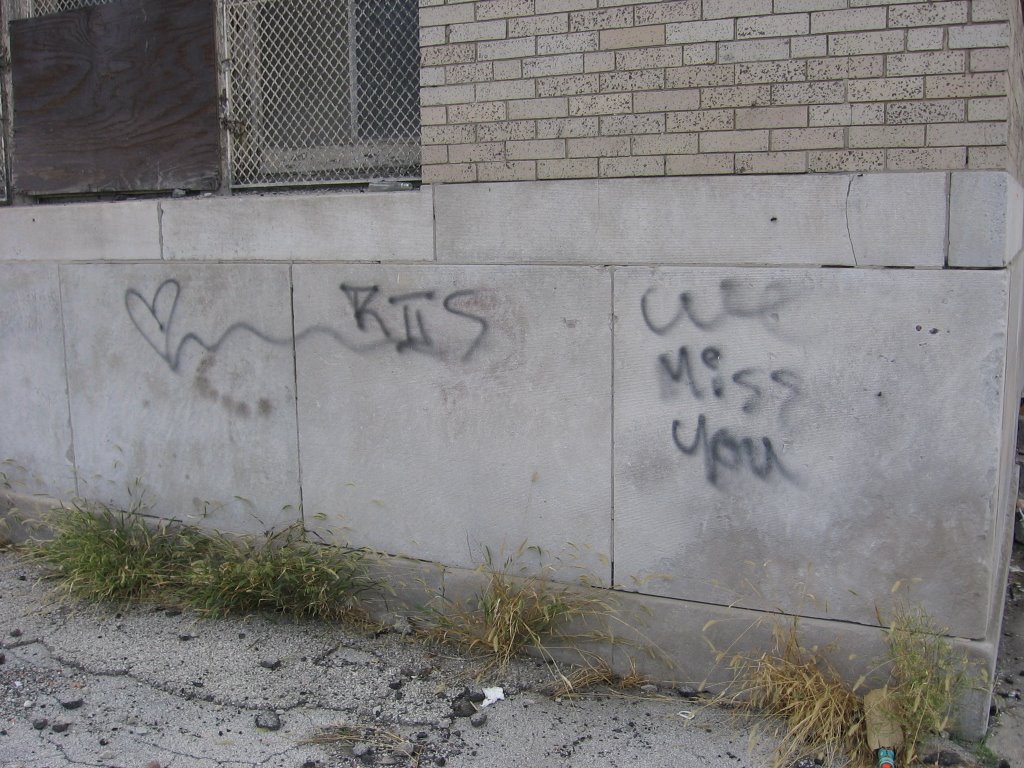 This near west-side Chicago school--Jacob A. Riis Elementary, named after the photojournalist of tenements--was recently shut down.
Discussion about this and other school closings wasn't encouraged by Chicago Public School officials, but citizens speak, anyway.
Riis was a casualty of the city's "Renaissance 2010" plan to close 100 public community schools (CT union) and open 100 performance (CT union), charter (non-CT union), and contract schools (non-CT union). While remaking neighborhoods (Ren 2010 boosts real estate profits--it's a gentrification project), the city is also re-making the labor of education; the good middle-class teaching job, once something to hold onto, is morphing into a temp-job model. Today teachers hop from school to school; charters have high turnover rates and often burnt-out staffs (without a union, the work-day is as long as the principal--or CEO--says it is). It's a sad condition for what was once a strong union town, where workers fought and died to gain the eight hour day.
Subscribe to:
Posts (Atom)